
By Chief Chuck E Carroll
In the 1950s a fire chief in Parkersburg, West Virginia, named Lloyd Layman changed how we fight fire. He said you don't run into a building. You read it first. Where's the fire going? What's it going to do? What's it going to take? He gave us the word every rookie still learns: size-up. Rescue, exposures, confine, extinguish. Look before you go in. Predict the fire, and you can beat the fire.
Forty years later a risk man named Gordon Graham stood in front of a thousand firefighters and cops and said the line we all know. If it's predictable, it's preventable.
We took both of those men at their word. We built an entire profession on them. Pre-plans. Hydrant maps. Smoke behavior. Flashover training. We can tell you what a house is going to do before the first line is pulled.
Here is what we never did.
We never sized up the firefighter.
We know what the job does to a person. It is not a mystery. It is the most predictable injury in the fire service. Put a human being in front of dead kids, burned bodies and screaming families for twenty-five years, and here is what happens: the nightmares come. The drinking comes. The marriage goes. The silence gets long. And some of us don't make it home, not from the fire, but from the quiet after.
We know this the way we know a lightweight truss roof is going to fail. The numbers are not a secret. In 2017, at least 103 firefighters died by suicide. Ninety-three died in the line of duty. For police it was 140 to 129. And those are only the ones reported; the Firefighter Behavioral Health Alliance estimates only about 40 percent of firefighter suicides are ever reported. In one national study, nearly half of firefighters had thought about suicide. Thirty percent of first responders develop a condition like PTSD or depression. For everybody else, it's 20 percent. We can predict it to the year.
Predictable. And we prevent none of it.
Everything we do for PTSD is after. After the bad call, maybe a debrief. After the breakdown, maybe a counselor. After the DUI, maybe a program. After the funeral, a peer support team gets formed, and everyone says we should have seen it coming.
We did see it coming. We just never called it a fire.
There is a word for help that only shows up after the damage. Postvention. That's all we've got. A whole profession built on reading the building before you go in, and when it comes to our own people, we wait for the roof to come down and then we send flowers.
Why? Because prevention means saying out loud, at the academy, on day one, that this job will hurt you. It means a chief standing in front of a crew and saying the word PTSD before anybody has it. It means admitting the thing we were all trained not to admit. Nobody wants to be the one to say it. So nobody does.
Layman would have called that a failed size-up. Graham would have called it a lawsuit waiting to happen. I call it the reason I didn't sleep for years.
Prevention isn't a pamphlet in the break room. It's a chief saying the word first.
I spent my career as a firefighter. The job gave me PTSD on the engine, years before anyone pinned the brass on me. I finished as a deputy chief, which means I know exactly how the system treats the people who ask for help, because I ran that system. Then COVID gave me a brain injury. I lost my words for a while. They still make a guest appearance in my brain now and then.
As far as I can find, there are two people in the world who climbed to chief and now live with both a brain injury and PTSD and are willing to say so out loud. The other is Chief Matt Shobert, medically retired in 2014 after a rock from a brush-clearing machine nearly killed him on a call. I'm the other one. That isn't a brag. It's a size-up. It means I've seen this from the nozzle, from the chief's office, from the hospital bed, and from three in the morning. I'm the subject matter expert on this fire because I've been inside it from every door.
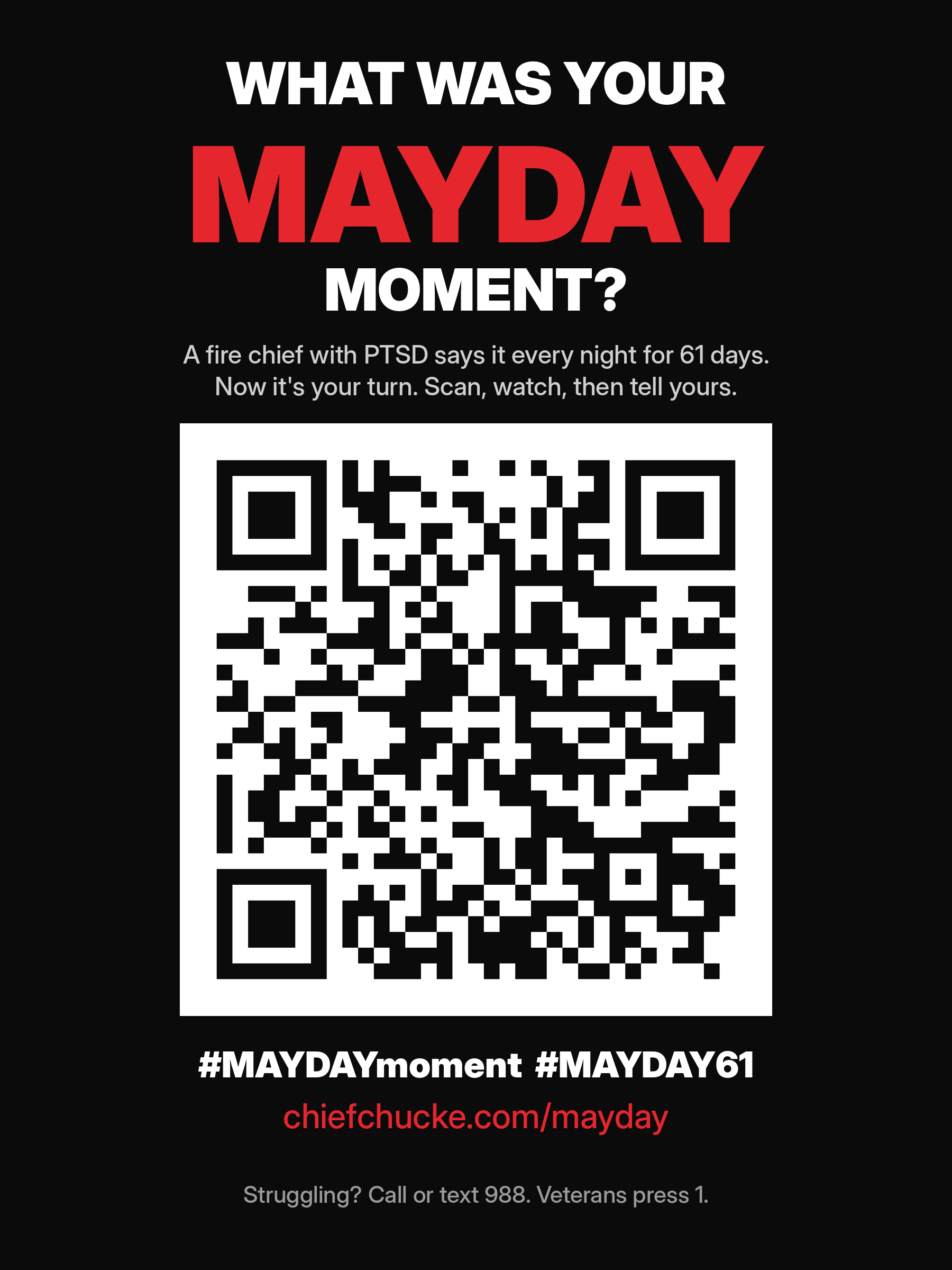
Since November 1, for 61 days, I've been doing what the profession never did. I'm sizing up the firefighter, out loud, every day at six o'clock, one short video at a time. What PTSD is. What it looks like before it's a crisis. What it costs. What actually works, by name, so you can ask for it. And what to do tonight.
I'm calling it MAYDAY, because that's the one word we're all trained to say and almost none of us ever say for ourselves.
No department asked me to do this. No agency is paying for it. Nobody at the top wants to stand up and say the job will hurt you before it does. So I will. That's what prevention from the top looks like. It looks like one of us who made it to the top, turning around and telling the truth to the ones still coming up.
If it's predictable, it's preventable. We've known that for forty years.
It's time somebody applied it to us.
The first video posted November 1. The last one posts New Year's Eve. If you wore a uniform, or you love someone who did, watch one. Then send it to someone who needs it. That's the whole ask. That's the mayday.
Struggling? Call or text 988. Veterans: 988, press 1. Responders: Safe Call Now, 206-459-3020.
Opinion. The views here are the author's own. He does not speak for any fire department or public agency. No one paid him for this piece. The MAYDAY series is fully funded by The UnNormal Foundation.
Chief Chuck E Carroll is a career firefighter and the CEO of The UnNormal Foundation. He lives with a brain injury and job-related PTSD. He is the author of Welcome to Your New UnNormal and the voice of MAYDAY: 61 Days, a daily video series for first responders and veterans running Nov. 1 through Dec. 31 at chiefchucke.com. Contact: Chief@MyUnNormalLife.com.
Revised November 23, 2026: updated the author's title and added the disclosure above. First published November 1, 2026.
Sources, for the editor: Lloyd Layman, Attacking and Extinguishing Interior Fires (1955) and the RECEO size-up model; Gordon Graham, risk-management lectures to public safety agencies ("if it's predictable, it's preventable"); Ruderman Family Foundation, Police Officers and Firefighters Are More Likely to Die by Suicide Than in the Line of Duty (2018); SAMHSA, First Responders: Behavioral Health Concerns, Emergency Response, and Trauma (May 2018); Stanley et al., 2015 survey of 1,027 U.S. firefighters; Chief Matt Shobert's story as told at EMS World Expo and in his books After the Rescue and A Little Help Here!